Erucic Acid in Mustard Oil: Scientific Analysis, Health Effects, Safety & Regulations
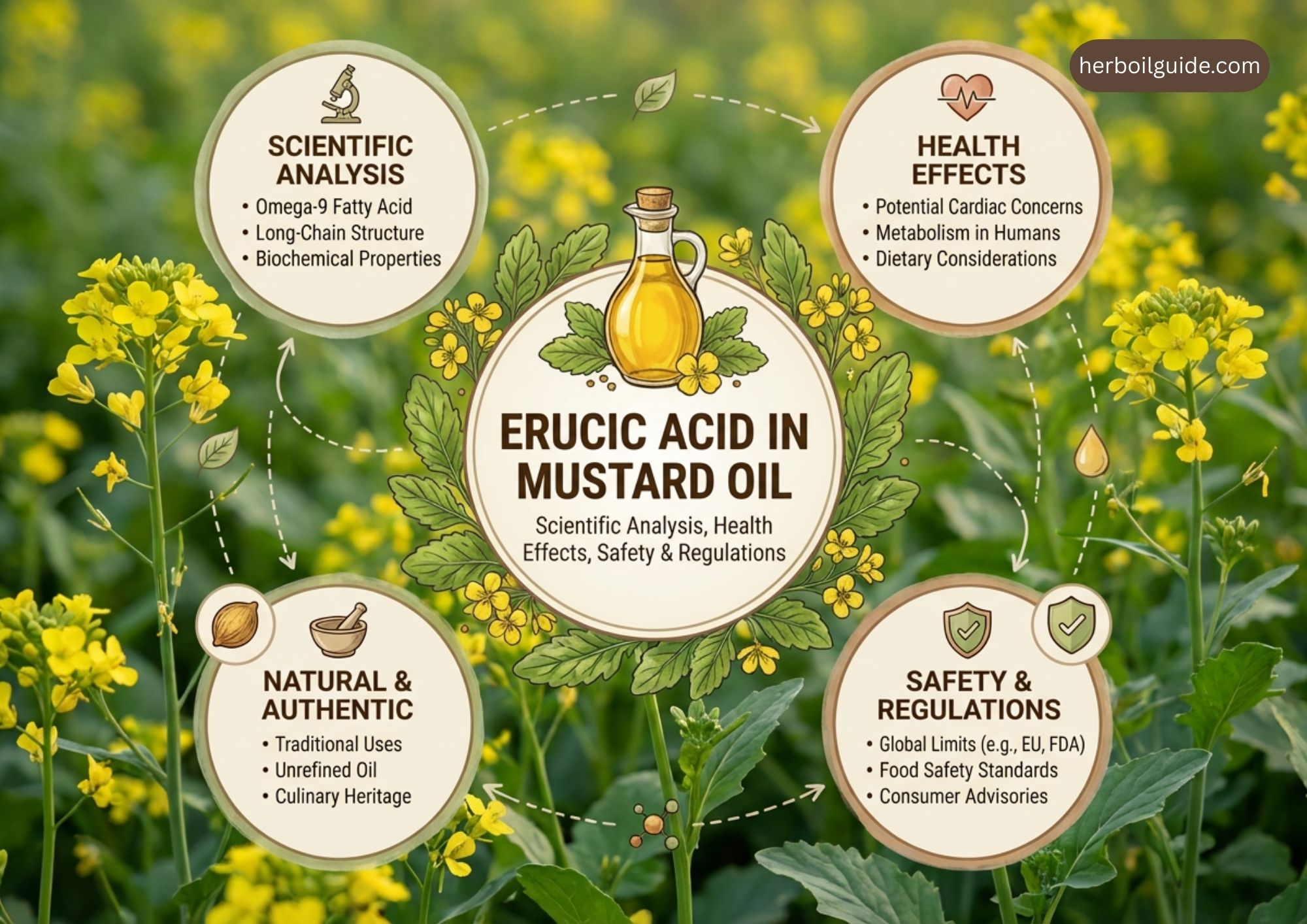
Erucic acid in mustard oil has long been one of the most discussed and misunderstood topics in edible oil science. Questions like “is erucic acid harmful?”, “why is mustard oil banned in some countries?”, and “what is the safe intake of erucic acid?” continue to shape consumer perception, food regulations, and export policies worldwide.
This erucic acid scientific analysis explains the compound from a biochemical, nutritional, regulatory, and real-world consumption perspective—clearly separating toxicity myths from evidence-based health facts.
In this article, you'll learn:
- What Erucic Acid Is and Where It Comes From
- Why Erucic Acid in Mustard Oil Matters
- Typical Erucic Acid Content & How Processing Affects It
- How Erucic Acid is Metabolized in the Body
- Animal Studies vs Human Evidence on Health Effects
- Is Erucic Acid Harmful? Understanding Dose-Dependent Toxicity
- Mustard Oil and Heart Health: Myth vs Evidence
- Erucic Acid vs Omega Fatty Acids
- Low Erucic Acid Mustard Oil & Agricultural Advances
- Erucic Acid Regulations & Global Intake Limits
- Why Is Mustard Oil Banned in Some Countries?
- Erucic Acid Side Effects & Safe Intake Guidelines
- Non-Dietary Uses of Mustard Oil (No Health Risk)
- Final Scientific Verdict
Let’s explore the science behind erucic acid and separate the facts from the fear.
What Is Erucic Acid? (Chemical & Biological Profile)
Erucic acid is a naturally occurring long-chain monounsaturated fatty acid (22:1, omega-9) that belongs to the group known as very-long-chain fatty acids (VLCFAs). From a chemical standpoint, its extended carbon chain gives it unique metabolic behavior compared to shorter fatty acids like oleic acid. Biologically, erucic acid is metabolized more slowly in the human body, which is why its intake has been closely studied in relation to heart health and long-term dietary safety.
Natural Occurrence in Edible Oils
Erucic acid is not an artificial or adulterant compound—it occurs naturally in several plant-based oils, particularly those derived from the Brassica family. Common natural sources include:
- Mustard Oil
- Traditional rapeseed oil
- Other Brassica seed oils
Among all edible oils containing erucic acid, mustard oil stands out as one of the richest natural sources, which explains both its distinctive nutritional profile and the regulatory attention it receives globally.
Why Erucic Acid in Mustard Oil Matters
Erucic acid plays a central role in how mustard oil is perceived by consumers, regulators, and health professionals worldwide. Concerns around heart health, long-term dietary safety, and regulated intake levels have shaped public discussion and policy decisions related to mustard oil consumption. These concerns are not linked to adulteration or poor quality but stem from mustard oil’s naturally higher erucic acid content compared to many other edible oils.
This issue directly influences consumer trust, as health-aware buyers increasingly seek clarity on fatty acid composition and safe usage levels. For mustard oil business, erucic acid limits determine compliance with food safety regulations, labeling requirements, and eligibility for domestic and international markets. From an export perspective, countries with strict erucic acid thresholds closely monitor mustard oil imports, making regulatory alignment essential for global trade.
Medical and dietary recommendations are also shaped by this factor, with guidance often emphasizing moderation, balanced diets, and the use of regulated, tested mustard oil products. Understanding why erucic acid matters helps consumers make informed choices, supports responsible business practices, and ensures that mustard oil continues to be used safely within modern nutritional and regulatory frameworks.
Erucic Acid Content in Mustard Oil (Explained Clearly)
Mustard oil naturally contains higher levels of erucic acid compared to most commonly used edible oils such as sunflower, soybean, or olive oil. This characteristic is inherent to the mustard seed itself and not the result of processing or contamination. Because of this naturally high concentration, mustard oil is often subject to specific consumption guidelines, regulatory limits, and labeling requirements in many countries.
Understanding what erucic acid is—and why mustard oil contains more of it—helps consumers separate natural composition from misinformation, and allows them to make informed choices about moderation, quality, and compliance rather than avoiding mustard oil based on incomplete context.
Typical Erucic Acid Levels in Mustard Oil (What Consumers Should Know)
Traditional mustard oil typically contains about 20–50% erucic acid as a proportion of total fatty acids, making it naturally higher than most common edible oils. This range is not fixed and can vary significantly based on several agricultural and processing factors. The mustard seed variety plays a primary role, while soil quality, climate conditions, and regional growing practices further influence the final fatty acid composition. Even the extraction method contributes to variation, which is why erucic acid levels are not identical across all mustard oils.
How Processing Affects Erucic Acid Levels
Processing methods influence concentration, not the existence, of erucic acid. Cold-pressed or kachi ghani mustard oil retains the oil’s natural fatty acid profile, including erucic acid, because it avoids excessive heat and chemical treatment. This preserves nutritional integrity but does not reduce erucic acid levels.
Refining processes may slightly lower erucic acid exposure, mainly through fractionation and heat treatment, but they do not eliminate it entirely. Similarly, blended mustard oils dilute erucic acid by mixing mustard oil with low-erucic oils; however, this approach reduces transparency and alters the oil’s traditional identity.
The key point for consumers and businesses alike is that processing does not create erucic acid—it is a naturally occurring component of mustard oil. Processing only adjusts its concentration, which is why quality sourcing, clear labeling, and informed consumption matter more than the method alone.
Erucic Acid Metabolism & Fatty Acid Processing in the Body
Erucic acid is metabolized differently from shorter-chain fatty acids because of its very long carbon chain (22:1) structure. In the human body, fatty acids are typically broken down through beta-oxidation to produce energy, but erucic acid undergoes this process more slowly than common fatty acids such as oleic or linoleic acid. This slower oxidation rate means erucic acid tends to remain in tissues for a longer period before being fully metabolized.
Scientific research suggests that the body’s limited efficiency in rapidly oxidizing very-long-chain fatty acids is the reason erucic acid has attracted nutritional and regulatory attention. When consumed in high amounts over long periods, slower metabolism may increase the likelihood of accumulation, which is why health authorities emphasize moderation and regulated intake rather than complete avoidance.
Importantly, the body can still process erucic acid, especially when intake levels remain within established dietary guidelines and when it is consumed as part of a balanced diet rich in diverse fats. This metabolic characteristic explains why erucic acid is not inherently toxic, but instead dose-dependent, reinforcing the need for informed consumption rather than fear-based avoidance of mustard oil.
Fatty Acid Metabolism Explained
Erucic acid is absorbed in the digestive system in the same way as other dietary fats, entering normal lipid transport pathways after consumption. Once absorbed, it undergoes β-oxidation at a slower rate because of its very-long-chain molecular structure. This metabolic processing occurs primarily in the liver, which is responsible for handling complex fatty acids.
This slower fatty acid metabolism—rather than direct toxicity—formed the basis of early safety concerns surrounding erucic acid. Those concerns were largely derived from metabolic behavior observed under experimental conditions, highlighting the importance of understanding how dosage and dietary context influence health interpretations.
Erucic Acid Health Effects: Animal Studies vs Human Evidence
Animal Studies & Myocardial Lipidosis
Early toxicological research on erucic acid relied heavily on animal models, where extremely high and purified doses were administered. These studies observed:
- Temporary fat accumulation in heart muscle tissue (myocardial lipidosis)
- Effects occurring under non-dietary, exaggerated exposure levels
- Reversibility of symptoms once high-dose exposure stopped
These findings led researchers to define the mechanism as dose-dependent, rather than inherently toxic. It is important to note that animal metabolism of very-long-chain fatty acids differs significantly from human metabolism, particularly in cardiac tissue.
Human Evidence & Real-World Consumption
Human data tells a markedly different story. Epidemiological and population-based studies from regions with long-standing traditional mustard oil consumption show:
- No strong association between mustard oil intake and increased heart disease risk
- No confirmed evidence of long-term cardiac damage at normal dietary intake levels
- Consumption typically occurs as part of a mixed-fat diet, not as isolated erucic acid exposure
This contrast highlights a critical nutrition science principle: animal study results cannot be directly extrapolated to humans without context. Human dietary patterns, metabolic pathways, and intake levels differ substantially from controlled laboratory conditions.
Is Erucic Acid Harmful? Understanding Dose-Dependent Toxicity
The potential health risk of erucic acid cannot be judged in isolation. Its impact depends on how much is consumed, how frequently it is consumed, and the overall dietary fat composition.
Scientific evaluation shows that erucic acid behaves as a dose-dependent compound, meaning toxicity is linked to excessive and prolonged intake rather than normal dietary exposure. Key risk modifiers include the quantity consumed, duration of intake, and the balance of erucic acid with other omega fatty acids such as omega-3 and omega-6. A well-balanced diet significantly influences how the body metabolizes long-chain fatty acids, which is why erucic acid toxicity is better described as contextual rather than absolute.
Mustard Oil and Heart Health: Myth vs Evidence
Much of the concern around mustard oil and heart health stems from oversimplified interpretations of early research. Two common myths persist: that erucic acid always damages the heart and that mustard oil directly causes heart disease. However, available human dietary evidence does not support these blanket claims. The heart-related concerns originated largely from high-dose animal studies, not from population-level human consumption patterns. When mustard oil is consumed in typical culinary amounts as part of a mixed-fat diet, current evidence does not show a consistent or direct link to heart disease, reinforcing the importance of separating myth-driven fear from evidence-based risk assessment.
Scientific Reality
- No conclusive human evidence proves erucic acid heart risk at normal intake
- Populations with traditional mustard oil consumption do not show unique cardiac risk patterns
Erucic Acid vs Omega Fatty Acids
Erucic acid differs fundamentally from the more widely discussed omega fatty acids. Unlike omega-3 and omega-6 fatty acids, which are considered essential fats with established roles in inflammation control, brain function, and cardiovascular health, erucic acid is an omega-9 fatty acid with no proven essential biological function in the human diet. At low intake levels, erucic acid is generally considered metabolically neutral, but at higher or prolonged intake, regulatory bodies advise caution due to historical safety concerns.
From a comparative oil perspective, the contrast is clear. Canola oil contains less than 2% erucic acid, making it one of the lowest among edible oils. In contrast, traditional mustard oil naturally contains much higher levels, not because of processing differences but due to plant genetics. These rapeseed vs mustard oil differences emerged largely from selective plant breeding, where canola was specifically developed to minimize erucic acid content.
Low Erucic Acid Mustard Oil & Agricultural Advances
To align mustard oil with modern food safety standards, agricultural researchers introduced low erucic acid mustard oil varieties, often referred to as LEAR (Low Erucic Acid Rapeseed/Mustard). These cultivars are genetically selected to significantly reduce erucic acid levels while maintaining agronomic viability.
However, this shift comes with a clear trade-off. Lower erucic acid content often reduces mustard oil’s characteristic pungency and may alter its natural bioactive compound profile, which many consumers associate with traditional flavor, aroma, and cultural authenticity. As a result, LEAR mustard oil represents a balance between regulatory compliance and sensory identity, making it particularly relevant for export markets and health-focused consumers, while traditional mustard oil continues to dominate regional and culinary uses.
Erucic Acid Regulations & Intake Limits
Globally, erucic acid is subject to strict regulatory caps, reflecting a precautionary public health approach rather than confirmed human toxicity. International food safety authorities treat erucic acid regulation as a risk-management measure, especially for vulnerable populations and long-term dietary exposure.
Under Codex Alimentarius (WHO/FAO guidelines), the Codex erucic acid standard limits erucic acid to ≤ 2% of total fatty acids in edible oils intended for general consumption. This benchmark has become the foundation for many national regulations and international trade requirements.
In the European Union, erucic acid EU limits are rigorously enforced, with even stricter thresholds applied to infant and baby foods, where developing metabolic systems are considered more sensitive. The EU’s stance emphasizes consumer protection through conservative intake limits rather than evidence of widespread harm.
The United States (FDA) takes a more restrictive position on traditional mustard oil. Because of its naturally high erucic acid content, mustard oil is often not approved as a standard cooking oil and is commonly marketed as “for external use only”, despite its long history of culinary use in other regions.
In India, the Food Safety and Standards Authority of India (FSSAI) regulates mustard oil under edible oil standards, allowing its use while enforcing mandatory labeling, compositional limits, and compliance requirements to ensure informed consumer choice and safety.
Overall, these erucic acid regulations exist as a precautionary safeguard, not because of conclusive human evidence of toxicity at normal dietary intake levels. The regulatory focus remains on dose control, transparency, and vulnerable population protection, rather than an outright declaration that erucic acid is inherently harmful.
Why Is Mustard Oil Banned in Some Countries?
Mustard oil is not “banned” everywhere—but it is restricted in several countries due to erucic acid regulations, not because it is proven dangerous at normal dietary intake.
The commonly searched phrase “mustard oil banned erucic acid” can be misleading. In reality, most regulatory actions are based on precautionary policy, not confirmed human harm.
The Core Regulatory Reason
Traditional mustard oil naturally contains high erucic acid levels (20–50%), which exceed the ≤2% limits set by Codex Alimentarius and adopted by many Western food safety authorities. Rather than creating separate rules for culturally specific oils, regulators often favor edible oils that already meet low-erucic thresholds by default.
Why Some Countries Restrict Mustard Oil
Key regulatory considerations include:
- Precaution over proof: Limits are set based on animal data and theoretical risk, not strong human evidence
- Uniform food standards: Easier enforcement when all edible oils follow the same erucic acid cap
- Infant and long-term exposure concerns: Conservative safety margins for vulnerable populations
- Trade and labeling simplicity: Reduced regulatory complexity for imports and audits
As a result, countries like the United States and parts of Europe restrict traditional mustard oil as a cooking oil, even while allowing low-erucic varieties (LEAR) such as canola.
What This Does Not Mean
- It does not mean mustard oil is toxic
- It does not prove erucic acid causes heart disease in humans
- It does not imply adulteration or contamination
Instead, it reflects a risk-management preference for oils that naturally comply with global erucic acid limits.
Regulatory Reality in Simple Terms
High erucic acid + universal limits = restricted approval, not a confirmed safety failure.
This distinction is essential for consumers, health professionals, and mustard oil businesses—especially those involved in export, labeling, and regulatory compliance.
Erucic Acid Side Effects & Safe Intake
Erucic acid side effects are a concern only at high and prolonged intake levels—not at normal, traditional dietary use.
Possible Side Effects (High Intake Only)
- Lipid accumulation concerns: Observed mainly in high-dose animal studies
- Theoretical heart risk: Suggested by early research, not confirmed in humans
- Dose-related effects: Risk increases with excessive, long-term, single-oil consumption
Importantly, these effects were linked to purified, extreme dosing, not real-world dietary patterns.
Erucic Acid Safe Intake Guidelines
To minimize any potential risk while respecting traditional food practices:
- Avoid excessive daily dependence on a single oil
- Rotate edible oils to balance fatty acid intake
- Maintain a diet rich in omega-3 and omega-6 fatty acids
- Follow regional food safety standards and labeling guidelines
This approach aligns with modern nutritional science, which emphasizes overall dietary fat composition, not fear of a single fatty acid.
Non-Dietary Uses of Mustard Oil (No Health Risk)
Non-edible applications involve no metabolic exposure, making erucic acid toxicity irrelevant in these contexts:
- Hair oil & massage: External use only, no dietary absorption
- Skin care: Acts as a natural emollient and barrier oil
- Industrial lubrication: Functional use, unrelated to human health
These uses remain widely accepted even in countries that restrict mustard oil for cooking.
Bottom line: Erucic acid risk is contextual and dose-dependent, not absolute. When used moderately and within a diversified diet, mustard oil does not pose a proven health threat—while its non-dietary uses carry no safety concerns at all.
Final Scientific Verdict
Erucic acid in mustard oil is not a poison, nor a modern contaminant. It is a naturally occurring long-chain monounsaturated fatty acid whose health impact depends on dose, metabolism, and overall dietary context—not on its mere presence.
Balanced, evidence-based conclusion:
- ❌ Myth: Erucic acid is toxic at normal dietary intake
- ⚠️ Caution: Excessive, long-term, single-oil dependence is discouraged
- ✅ Reality: Safe when consumed in moderation as part of a balanced diet
- ✅ Fact: No risk in non-culinary uses (hair, skin, massage, industrial)
Modern nutrition science and regulatory reviews support informed moderation, oil rotation, and dietary balance—not fear-driven avoidance.
In short, erucic acid risk is dose-dependent and contextual, not absolute.
Frequently Asked Questions (FAQs)
1. What is erucic acid in mustard oil?
Erucic acid is a naturally occurring long-chain monounsaturated fatty acid (C22:1) found in traditional mustard oil. Its concentration varies depending on mustard seed variety and processing method.
2. Is erucic acid harmful to human health?
Erucic acid is not harmful at normal dietary intake levels. Health concerns observed in studies were linked to excessive, long-term consumption, mainly in animal models, not typical human diets.
3. What do scientific studies say about erucic acid today?
Modern scientific reviews confirm that erucic acid’s effects are dose-dependent, and moderate intake within a balanced diet is not associated with proven health risks in humans.
4. Is mustard oil banned worldwide because of erucic acid?
No. Mustard oil is widely consumed in South Asia, parts of Europe, and Africa. Restrictions apply mainly to labeling or specific erucic acid thresholds, not total bans.
5. Are low-erucic mustard oils safer?
Low-erucic mustard oils meet international edible oil standards and are preferred in regions with strict regulations, though traditional mustard oil remains safe when used moderately.
6. Is erucic acid present in other edible oils?
Yes. Small amounts of erucic acid are found in rapeseed oil and some seed oils, though modern edible oils usually contain reduced levels.
7. Can erucic acid be removed from mustard oil?
Erucic acid can be reduced through plant breeding (low-erucic varieties), not fully removed through standard oil processing.
8. Is mustard oil riskier than other edible oils because of erucic acid?
Not when consumed moderately. Risk depends on dietary balance and quantity, not the presence of a single fatty acid.
9. Is erucic acid a natural component of mustard oil?
Yes. Erucic acid is a naturally occurring fatty acid in mustard seeds and is not an artificial additive or contaminant.
10. Why do animal studies show toxicity while human studies do not?
Animal studies used extremely high, isolated doses of erucic acid, while human diets involve lower, mixed-fat consumption, leading to very different metabolic outcomes.
11. Does traditional cooking increase erucic acid risk?
No. Cooking does not increase erucic acid content. Risk is determined by total intake, not preparation method.
12. Is mustard oil riskier than other edible oils because of erucic acid?
Not when consumed moderately. Health risk depends on quantity and overall dietary composition, not solely on erucic acid presence.